
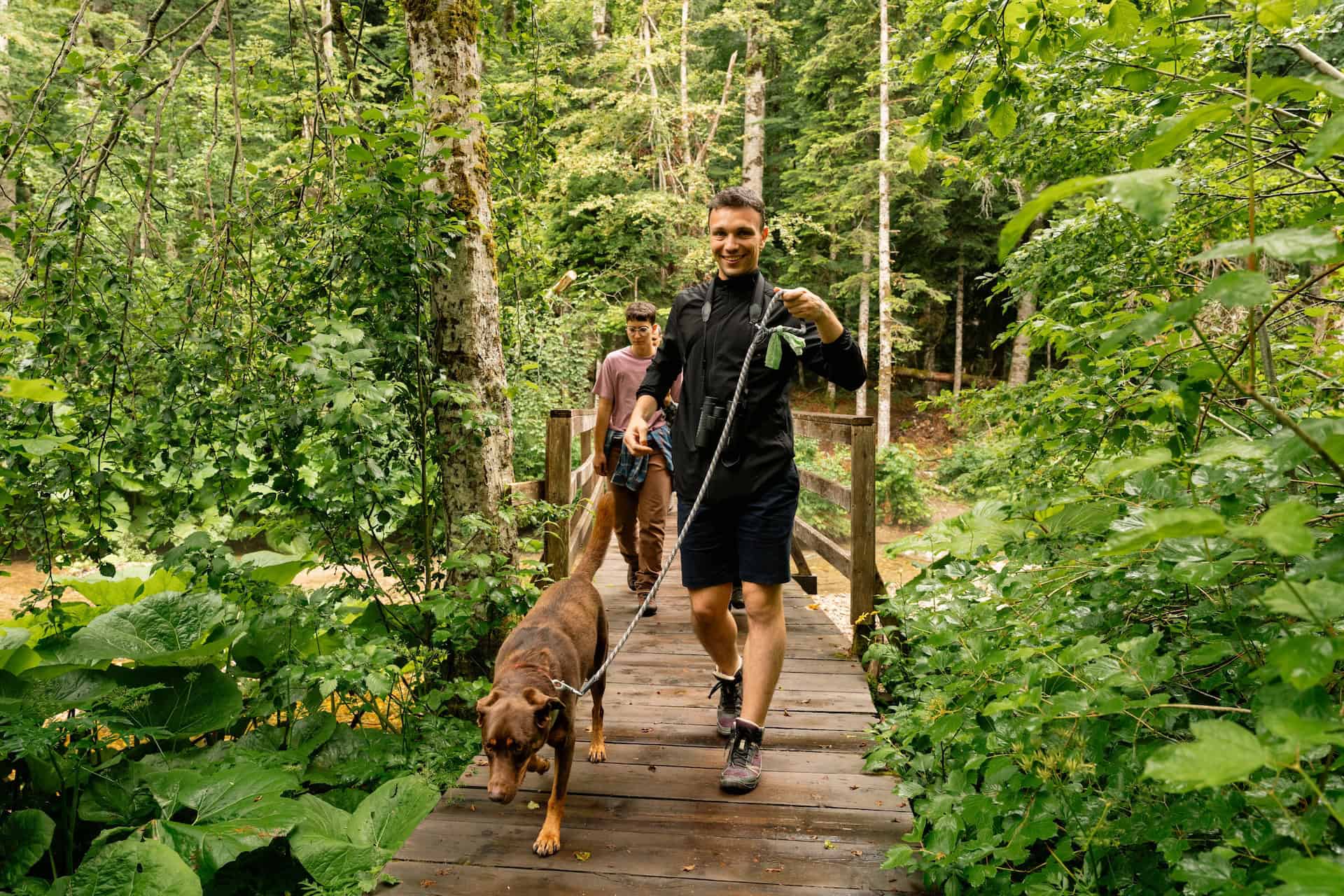
Dogs used for hunting, forestry, herding, monitoring or other outdoor work may enter large-carnivore habitat before their handlers and may move beyond direct control. This can increase the risk of encounters, particularly when a dog approaches a carnivore, its young, a resting site, a carcass or another defended resource.
Risk can be reduced through preparation, reliable control, GPS tracking, attention to recent wildlife information and a clear emergency plan. The safest approach is to prevent the dog from pursuing or approaching a large carnivore and to leave the area calmly when signs of recent activity are detected.
When and Why Dogs May Be at Risk
Most large carnivores avoid people and dogs. Encounters may nevertheless occur when dogs range widely, follow scent trails or enter areas that humans would normally avoid.
Risk may be higher:
- where wolves or bears have recently been recorded;
- near breeding, resting or denning areas;
- near carcasses, feeding sites or other food resources;
- when dogs move far ahead of their handlers;
- during low-visibility conditions;
- in dense vegetation or rugged terrain;
- when several dogs pursue or surround an animal;
- when a dog behaves territorially or gives chase.
Wolves may perceive an unfamiliar dog as a competitor or intruder, particularly when the dog enters an area used by a pack. Bears may react defensively when surprised at close range, when accompanied by cubs or when guarding food.
The D1.2.2 e-guidebook stresses that field activities should be planned using recent observations, tracks, camera-trap information and knowledge from local experts. The same precaution is relevant when dogs are used in large-carnivore areas.
Preparing the Dog Before the Activity
Preparation should focus on control, fitness and the ability to end the activity quickly.
Before entering the field:
- ensure that the dog responds reliably to recall commands;
- practise stopping and returning under distraction;
- check identification and registration details;
- make sure vaccinations and veterinary care are up to date;
- inspect collar, lead and tracking equipment;
- carry water and basic first-aid supplies;
- check recent information about carnivore activity;
- inform another person of the planned route and return time;
- save the telephone numbers of local authorities and a veterinarian.
Young, inexperienced or poorly controlled dogs should not be allowed to range freely in areas with recent wolf or bear activity.
Handlers should also understand the limits of the dog. Fatigue, excitement and strong scent trails can reduce responsiveness even in well-trained animals.
Using Leads, GPS Devices and Protective Equipment
A lead is the most reliable way to prevent a dog from approaching wildlife. Dogs should be kept close when:
- fresh carnivore signs are present;
- visibility is poor;
- approaching a carcass or feeding area;
- passing through a known corridor or sensitive site;
- authorities have issued a warning;
- the handler cannot see or recall the dog immediately
GPS collars can help handlers monitor direction, distance and unexpected changes in movement. A tracking device should not, however, be treated as a substitute for control. Knowing where a dog is does not necessarily make it possible to stop an encounter.
Before departure:
- fully charge the device;
- confirm mobile or radio coverage;
- test the connection;
- set an appropriate distance alert;
- carry a backup map or navigation device
Protective collars or vests may offer some protection in particular working contexts, but they cannot prevent every injury and should not encourage dogs to be sent into high-risk situations. Their use should follow veterinary and local professional advice.
Recognising Signs of Large Carnivore Presence
Recognising recent signs allows the handler to change direction before an encounter occurs.
Possible signs include:
- fresh tracks;
- scats;
- hair on vegetation or rubbing sites;
- scratching or scent-marking;
- recent camera-trap or telemetry information;
- howling or other vocalisations;
- concentrated scavenger activity;
- a fresh carcass or remains of prey;
- unusual behaviour from the dog, such as intense scenting, barking, freezing or refusal to advance.
The e-guidebook identifies tracks, scats, photographs, vocalisations and mortality or predation records as useful evidence of large-carnivore presence. Such observations should be recorded carefully and, where possible, validated before being used for wider management decisions.
A carcass should be treated as a potential risk area. Do not allow the dog to investigate it, and do not approach closely to determine what killed the animal.
What to Do During a Dog–Carnivore Encounter
General response
Recall the dog immediately.
- Put the dog on a lead as soon as this can be done safely.
- Do not allow chasing, barking at close range or surrounding the animal.
- Remain calm and avoid running.
- Give the carnivore space and a clear escape route.
- Move away slowly.
- Do not approach to take photographs.
- Do not attempt to intervene physically between the animals.
Encounter with a wolf
Call the dog back and remain together. A dog running towards the handler may bring the wolf closer, so the handler should stay calm, make their human presence clear and move away without running.
Do not release additional dogs. Do not encourage pursuit. If the wolf remains nearby or shows repeated close approaches, leave the area and report the behaviour.
Encounter with a bear
Recall and control the dog immediately. A loose dog may provoke a bear and then return to the handler.
Do not approach the bear, cubs or a carcass. Avoid sudden movements and slowly increase the distance. Never block the bear’s escape route.
If the dog cannot be recalled without placing the handler at greater risk, personal safety must come first. Contact the competent authorities as soon as possible.
Managing Injuries and Reporting an Incident
After an encounter:
- move to a safe location;
- place the dog on a lead;
- check for bleeding, punctures, breathing problems or signs of shock;
- contact a veterinarian immediately;
- avoid unnecessary handling of serious wounds;
- record the location, time and circumstances;
- notify the competent wildlife or hunting authority.
Even small puncture wounds may hide deeper injuries and require veterinary assessment.
A useful incident report should include:
- date and time;
- exact location or GPS coordinates;
- species believed to be involved;
- number of carnivores and dogs;
- whether the dog was free-ranging or on a lead;
- description of the encounter;
- injuries sustained;
- presence of cubs, carcasses or food sources;
- photographs, tracks or other evidence collected without additional risk.
Standardised reporting supports monitoring and helps authorities identify recurring risk areas. The e-guidebook recommends recording location, date, species and supporting evidence, followed by expert validation before data are included in monitoring systems.
Legal and Local Rules
Rules concerning dogs, hunting, wildlife disturbance and protected areas vary among countries and regions.
Before the activity, check:
- whether dogs may be released in that area;
- permitted hunting seasons and methods;
- protected-area access restrictions;
- temporary closures around sensitive wildlife sites;
- requirements for identification or GPS equipment;
- obligations to report wildlife incidents;
- rules applying to injured or dead protected animals.
Never pursue, capture, disturb or attempt to remove a large carnivore. Wolves and bears are subject to national and international wildlife legislation, and authorised interventions may only be carried out by competent personnel.
This page should therefore include country-specific links and contacts rather than presenting a single legal rule for the entire Adriatic–Ionian region.