
Forests provide large carnivores with shelter, food resources, breeding and resting sites, and routes for moving between suitable habitats. Forestry is also an essential economic and social activity. Large-carnivore-friendly forest management therefore does not mean excluding people or productive activities from forests. It means planning and carrying out those activities in ways that avoid unnecessary disturbance, retain important habitat features and maintain connections across the wider landscape.
This best practice presents a precautionary and adaptive approach for forest owners, managers and workers. Before forestry operations begin, available wildlife data should be considered together with information on protected areas, ecological corridors and recent species observations. Operations should then be scheduled and organised according to local conditions, legal requirements and the sensitivity of the site.
Because large carnivores move across extensive territories and frequently cross administrative borders, decisions made in one forest can affect habitats and movement routes at a much broader scale. Coordination among forestry services, wildlife authorities, protected-area managers, researchers, hunting organisations and neighbouring land managers is therefore an essential part of responsible forest management.
The Relationship Between Forestry and Large Carnivore Habitats
Large carnivores depend on landscapes rather than on isolated forest stands. Brown bears, grey wolves and Eurasian lynx may use extensive home ranges containing forests, pastures, shrublands, agricultural areas and human infrastructure. Golden jackals are more adaptable to open and human-modified landscapes, but may also use forest edges, scrub and connected vegetation for shelter and movement.
Forests can provide several resources:
- secluded areas for resting and shelter;
- cover for movement;
- breeding or denning sites;
- natural food resources;
- habitat for wild prey;
- links between larger areas of suitable habitat.
Large carnivores also contribute to forest ecosystem functioning. Wolves and lynx can influence the abundance, distribution and behaviour of wild ungulates. This may reduce browsing pressure in some areas and support natural regeneration. Carnivore kills also provide food for scavengers and return nutrients to the ecosystem. The golden jackal contributes through predation on smaller animals and the consumption of carrion.
Forestry activities can have both positive and negative effects. Well-planned management may maintain heterogeneous forest structure, support prey habitats, restore degraded areas and protect ecological corridors. Poorly planned operations may remove shelter, increase access to previously remote areas, fragment habitat or repeatedly disturb animals at sensitive sites.
The objective should not be to keep every forest unchanged. It should be to maintain the ecological functions that large carnivores require while allowing sustainable forestry to continue.
Identifying Sensitive Areas and Periods
Before approving or starting forestry work, managers should assess whether the operational area overlaps with locations or periods that may be particularly important for large carnivores.
Potentially sensitive areas include:
- confirmed or suspected breeding and denning sites;
- regularly used resting areas;
- narrow ecological corridors or landscape bottlenecks;
- routes connecting larger forest blocks;
- areas repeatedly used by monitored animals;
- sites with recent evidence of females with young;
- remote forest patches offering limited alternative shelter;
- locations used for scientific monitoring or authorised capture operations.
The assessment should combine several sources of information. These may include official distribution maps, protected-area records, camera-trap data, telemetry, genetic sampling, tracks, scats and verified observations from foresters, hunters or local residents. Opportunistic observations can improve geographical coverage, but they should be validated before being used for operational decisions.
Sensitivity varies among species, individuals, seasons and regions. There is therefore no single calendar that can be applied across the entire Adriatic–Ionian region. Breeding seasons, den use and national protection rules differ between countries. Forest managers should obtain locally verified information from the competent authority rather than relying on general dates.
Where uncertainty remains, apply a precautionary approach:
- verify the most recent available data;
- consult the responsible wildlife or protected-area authority;
- assess whether the operation can be postponed, relocated or modified;
- document the decision and the measures adopted.
Sensitive information must be handled carefully. Exact locations of dens, breeding sites or very rare animals should not be circulated more widely than necessary.
Planning Logging and Tree-Cutting Operations
Large-carnivore considerations should be integrated at the beginning of operational planning, rather than added after machinery and workers have already entered the site.
Assess the area before work begins
Review:
- the boundaries and scale of the planned operation;
- recent records of large-carnivore presence;
- proximity to protected areas and ecological corridors;
- forest roads and access routes;
- the availability of alternative shelter nearby;
- the possible cumulative effect of other operations in adjacent forests;
- national and local legal requirements.
Spatial models and connectivity maps can help identify areas that are suitable for large carnivores, likely movement routes and locations where habitat permeability is already limited. Connectivity assessments should inform not only major infrastructure projects, but also the placement and cumulative impact of forest clearings, roads and intensive operations.
Choose the least disruptive operational option
Where technically and economically feasible:
- avoid concentrating several disruptive activities in the same sensitive area;
- divide large operations into manageable phases;
- maintain undisturbed refuge areas during work;
- avoid creating unnecessary new access routes;
- use existing roads and extraction routes where their use will not worsen habitat fragmentation;
- retain vegetation along known or potential movement routes;
- adjust the timing of work when confirmed breeding, denning or repeated resting activity is present.
Avoid rigid prescriptions without local evidence
The appropriate measure depends on forest type, species presence, topography, legal status and the intensity of the operation. Fixed buffer distances and seasonal restrictions should only be stated when they are established by national law, protected-area rules or advice from the competent wildlife authority.
Record the planning decision
The operational plan should briefly document:
- the wildlife information reviewed;
- the authorities or experts consulted;
- the sensitive areas identified;
- timing or spatial adjustments;
- measures to reduce disturbance;
- procedures to follow if animals or signs are found during work.
This provides continuity when contractors, personnel or forest managers change.
Reducing Noise and Disturbance
Forestry operations may produce noise, vibration, traffic and repeated human presence. Large carnivores often avoid people, but the effect of disturbance depends on its intensity, duration, predictability and location.
Recommended measures include:
- limiting activity to the smallest area necessary;
- avoiding unnecessary idling of machinery;
- organising material transport efficiently to reduce repeated journeys;
- preventing simultaneous high-noise operations across adjacent refuge areas;
- maintaining predictable work periods rather than irregular activity throughout the day and night;
- avoiding night-time work in sensitive areas unless it is essential and authorised;
- keeping food and organic waste inaccessible to wildlife;
- not feeding or deliberately attracting carnivores;
- informing all workers about what to do if an animal, den or fresh signs are discovered.
Noise reduction should be combined with spatial planning. A short but very intensive operation that affects an entire refuge area may be more disruptive than a longer operation that leaves functional undisturbed zones. Managers should therefore consider how animals can move away from activity without being channelled towards roads, settlements or other hazards.
Monitoring can help determine whether mitigation is working. Camera traps and other non-invasive tools can document presence and activity patterns, but they must be deployed according to a clear objective and standardised design. Camera placement itself should minimise disturbance, human scent, unnecessary visits and the risk of revealing sensitive locations.
Retaining Shelter, Connectivity and Habitat Features
A forest should not be viewed only as a collection of stands managed separately. For large carnivores, its value also depends on how those stands connect to neighbouring forests, protected areas, pastures and other suitable habitat.
Maintain connected cover
Where possible, retain vegetation that links larger habitat patches, particularly:
- forest strips between otherwise separated blocks;
- wooded ridges and valley sides;
- forest edges connected to shrubland;
- riparian vegetation;
- narrow passages between roads, settlements or intensive land uses;
- stepping-stone patches that allow animals to cross modified landscapes.
Habitat connectivity has both structural and functional dimensions. Structural connectivity concerns the physical arrangement of landscape features. Functional connectivity concerns whether those features actually facilitate or hinder movement by a particular species. A corridor that appears continuous on a map may function poorly if it is affected by heavy traffic, intensive human use or other disturbance.
Retain a diversity of habitat features
Depending on the forest type and approved management objectives, consider retaining:
- areas of dense cover;
- mature and structurally complex patches;
- understory vegetation;
- natural regeneration;
- undisturbed rocky or inaccessible features;
- habitat elements important for wild prey;
- safe links between feeding, resting and movement areas.
This does not mean preserving every individual tree or preventing all harvesting. The aim is to avoid simplifying the forest to the point that shelter, prey habitat and movement opportunities are lost across the wider management unit.
Consider cumulative impacts
One small clearing or road may have a limited effect. Several neighbouring interventions may collectively create a barrier or remove most available cover. Forest managers should therefore coordinate with neighbouring owners, municipalities and protected areas, especially in recognised corridors and transboundary landscapes.
Working Near Breeding, Resting or Denning Areas
Confirmed or suspected breeding, resting and denning areas require particular care. Disturbance may cause animals to leave a site, move young, increase their exposure to people or roads, or lose access to secure shelter.
When such a site is identified:
- Stop or pause work in the immediate area.
- Do not approach the site to confirm it independently.
- Keep workers, vehicles and dogs away.
- Limit access until the situation has been assessed.
- Do not photograph, mark or publicly share the exact location.
- Sensitive data should only be provided to the competent authority or authorised expert.
- Contact the responsible authority.
- This may be a protected-area administration, wildlife agency, forestry service or another designated institution, depending on the country.
- Follow site-specific instructions.
- Measures may include a temporary exclusion area, a change in access route, postponement of work, reduced machinery use or specialist monitoring.
- Brief workers without disclosing unnecessary details.
- Personnel need clear operational instructions, but exact sensitive information should remain restricted.
- Reassess before work resumes.
- Resumption should be based on advice from the competent authority and current evidence, not simply on the passage of a predetermined number of days.
Do not attempt to move an animal, inspect a den, handle young or use machinery to encourage animals to leave. Management interventions involving protected wildlife require trained personnel, legal authority and, in some situations, specific permits.
Coordination With Protected-Area and Wildlife Authorities
Large carnivores frequently move beyond individual properties, forestry districts, protected areas and national borders. Forest management decisions should therefore be connected to broader monitoring and conservation systems.
Coordination should begin during planning and continue during implementation and follow-up.
Before operations
Forest managers should:
- identify the competent wildlife and protected-area authorities;
- request current information on known sensitive zones;
- check applicable legislation and permit conditions;
- agree on how confidential wildlife data will be handled;
- establish an incident-reporting procedure;
- confirm who can authorise changes when sensitive wildlife is detected.
During operations
Workers and contractors should know:
- who the designated contact person is;
- which signs or observations must be reported;
- when work must stop;
- how to record location, date, time and circumstances;
- how to avoid disturbing or attracting animals.
After operations
Where the site is particularly important, managers should consider:
- checking whether mitigation measures were implemented;
- recording unexpected observations or incidents;
- sharing validated information with monitoring programmes;
- reviewing whether roads, traffic or habitat changes affected animal use;
- updating future forest-management plans.
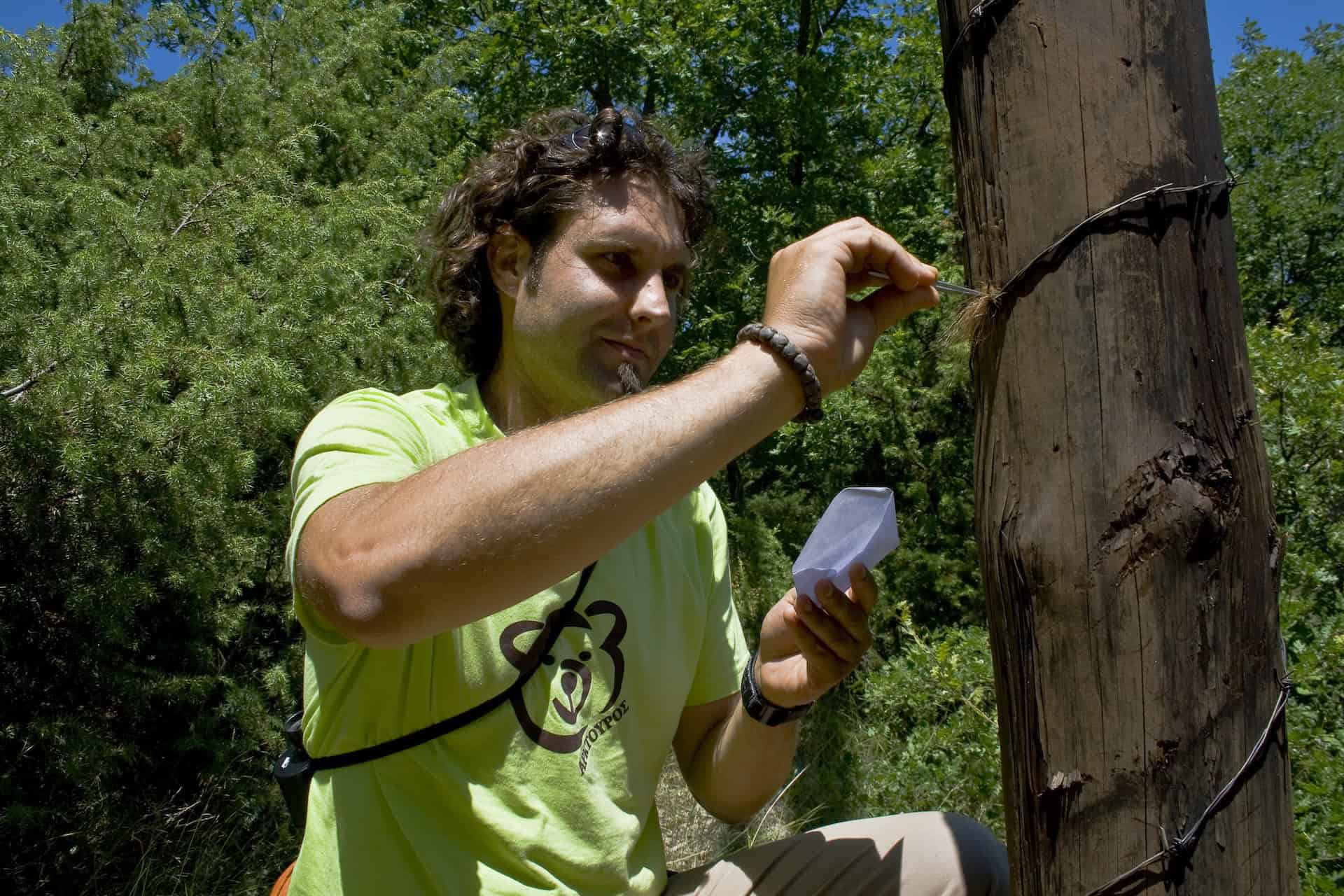
Foresters and hunters can make a valuable contribution to large-carnivore monitoring because they spend considerable time in areas that are difficult to survey systematically. Reports may include sightings, tracks, scats, vocalisations, photographs, mortality records or predation events. However, standardised reporting and expert validation are needed before these data are used in analysis or decision-making.
Because large-carnivore populations cross borders, compatible monitoring methods and cooperation between institutions are particularly important. Isolated local data may provide an incomplete picture of population status, habitat use and movement.